
A new patient question
A few weeks ago, I met a new patient, with no previous aesthetic treatments. No Botox. No filler. No laser.
As we were finishing our consultation, I happened to ask her a question, as I had sensed a real concern around injectables.
“Which scares you more, filler or a facelift?”
She replied. “Filler.” And she is far from alone.
HOW DID FILLER BECOME THE VILLAIN? And when did facelifts become fashionable?
Filler has taken on an unfair reputation.
Overdone. Dangerous. Pillow faces. Loss of identity. Migration.
Many patients worry about longevity, about product remaining in the face for too long, and about the risk of migration.
Let us be clear.
From a medical perspective, filler remains one of the most controllable and adaptable tools we have. When used correctly, it can restore lost volume, improve facial proportions, support tissue gently, and create beautifully hydrated, natural looking lips.
Importantly, injectable treatments are reversible to some extent. Not completely, but enough to allow correction, adjustment, and refinement.
Concerns about longevity often overlook a crucial point. Surgery is the ultimate commitment in longevity and irreversibility. Once performed, it cannot be undone.
ENTER THE ERA OF THE FACELIFT FANDOM
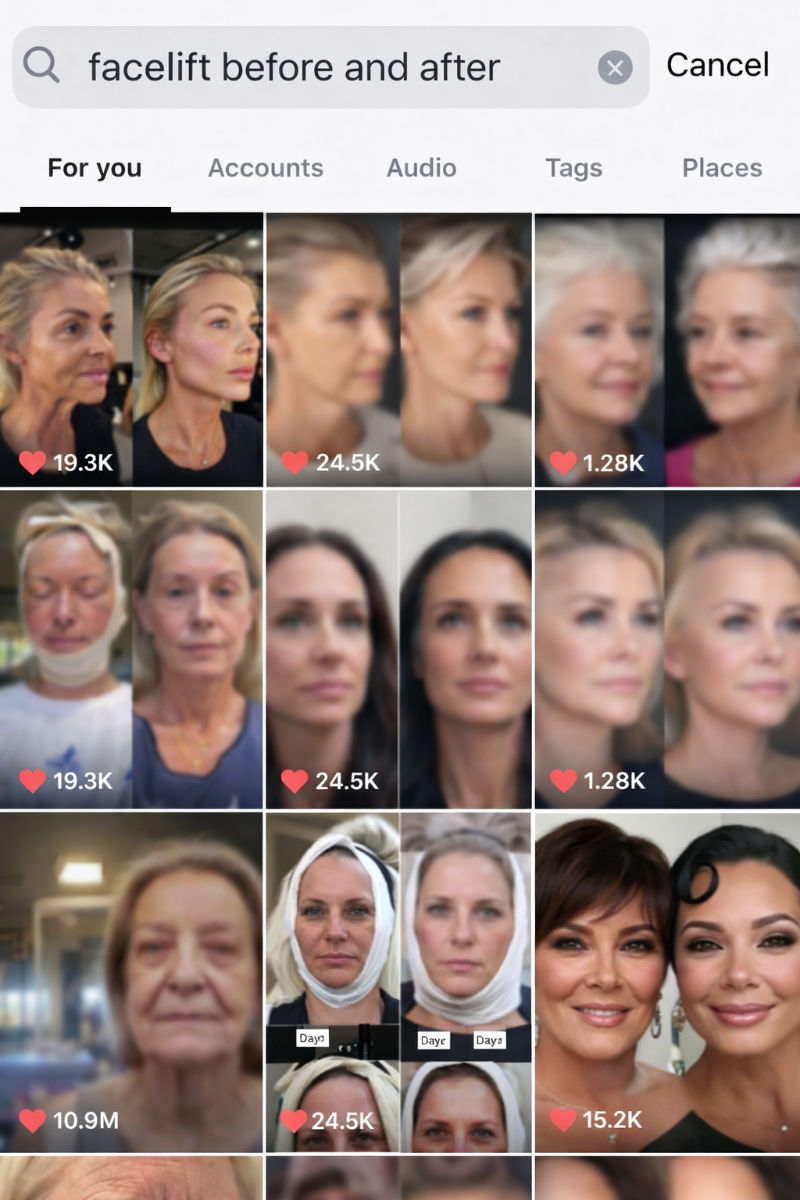
We are firmly in a new aesthetic moment. Facelifts are openly discussed. Waiting lists are long.
The question I now hear daily is no longer “Do I need one?” It is “When will I?”
Much of this renewed enthusiasm can be traced to highly visible celebrity examples. Kris Jenner’s transformation, in particular, has reframed what modern surgical outcomes can look like when done well.
There is a certain irony here. The same family that normalised lip filler through Kylie Jenner, and facial contouring and Brazilian butt lifts through Kim Kardashian, has now helped spark a renewed fascination with surgical lifting.
Have we not learnt from past cycles where aesthetic trends can lead? Call it the Instagram facelift era. Call it the Facelift Fandom.
Either way, the momentum is undeniable. Trends move. Faces follow. But thoughtful medicine should not blindly follow either.
A CHEMISTRY LESSON
My sister, who has a background in chemistry, was recently explaining to my son the difference between reversible and irreversible reactions.
A salad can be adjusted. Ingredients can be removed, added, or rebalanced. A cake, once baked, cannot be taken apart.
It is a surprisingly elegant analogy for aesthetics. Injectables such as filler and Botox are adjustable and modifiable to a degree. A facelift, however, is permanent.
Neither approach is wrong. They are simply very different commitments.
MY PERSONAL PHILOSOPHY
Anyone who knows me knows that I lean towards a minimalist approach. I never embraced overt filling trends at their peak.
That said, I have never dismissed filler when used thoughtfully, structurally, and conservatively. If surgery is your preference, then do it well. But do it at the right time and with the right preparation.
I would absolutely consider surgery myself when I feel the time is right. What I will never do is allow trends to make that decision for me.
THINGS TO CONSIDER BEFORE SURGERY
- Overall skin quality including pigmentation, redness, and texture
- Whether changes are driven by volume loss or true tissue descent
- Healing capacity and individual scarring risk
- Previous non invasive treatments and outcomes
- Lifestyle factors such as sun exposure, smoking, and stress
- Expectations around longevity and irreversibility
- Willingness to prepare the skin before surgery and support it afterwards
MATCHING CONCERNS TO TREATMENT TYPES
Skin texture, pigmentation, and redness benefit most from laser and device based therapies. More advanced tissue descent or laxity may ultimately require surgical intervention.
In many cases, the best outcomes come from combining these approaches thoughtfully, rather than rushing toward a single solution.
SKIN IS THE FOUNDATION
A facelift does not correct skin quality. It does not treat pigmentation, redness, texture, or sun damage.
At Fitzrovia Clinic, we rely heavily on advanced energy based technologies including LaseMD Ultra for fractional laser resurfacing and DermaV for vascular concerns such as redness and visible vessels. CO2 laser resurfacing may be used when appropriate for deeper correction.
These treatments help prepare the skin before surgery, improve healing afterwards, reduce scarring, and in many cases delay the need for surgery altogether.
THE SKINCARE REVOLUTION
Skincare has evolved alongside devices. Personalised compounded formulations now allow us to tailor treatment to skin biology, hormonal stage, and long term goals.
This is not cosmetic luxury. It is outcome focused medicine.
SO FILLER OR FACELIFT?
The answer is neither fear driven nor trend led. It is about timing, proportion, skin health, and resisting the urge to jump prematurely into irreversible decisions simply because they are fashionable.
And when it is time to bake the cake, make sure the ingredients are the best possible.
Dr Toni Burke
Fitzrovia Clinic, London