
You’ve probably seen collagen powders, drinks and capsules everywhere – from social media to your commute, and even on the shelves at Fitzrovia Clinic. But do they really improve your skin? How do they actually work? And where do they fit alongside treatments like lasers, microneedling and skin boosters?
While collagen supplements have been around for some time, their popularity has grown – and thankfully so has the evidence base behind their results.
Recent high-level scientific reviews have analysed dozens of clinical trials to understand what collagen supplements can – and cannot – do for skin health. The latest (and largest to date) was published just a few weeks ago, so I thought it would be helpful to summarise the research for you and explain why we recommend them.
If you would like to read the full article yourself, you can access it here.
What Is Collagen and Why Does It Matter?
Collagen is the main structural protein in your body, making up around 25–30% of all the protein you contain. It gives strength and elasticity to:
- skin
- joints
- tendons
- bones
- blood vessels
In the skin, collagen forms the dermal matrix, which is responsible for firmness, elasticity, hydration and resilience.
As we age, collagen production naturally declines. From early adulthood we lose roughly 1% of collagen each year, and during menopause this drop accelerates dramatically – women can lose around 30% of skin collagen within the first five years.
This reduction contributes to:
- thinner skin
- loss of elasticity
- dryness
- wrinkles
These changes concern many of our patients, and many of the treatments we offer – both in clinic and through our compounded skincare – are aimed at addressing them.
How Do Collagen Supplements Work?
One question I’m regularly asked is how the collagen in a supplement actually reaches the skin. After all, wouldn’t it simply be digested like other proteins and therefore have little impact on our connective tissues?
These are excellent questions – and ones that many supplement brands (and clinics) don’t fully explain.
Most collagen supplements contain hydrolysed collagen peptides. These peptides are collagen molecules that have been broken down into very small fragments so they can be absorbed more easily. The size of these peptides varies between brands, but more on that later.
After ingestion, these peptides reach the gut and some are absorbed into the bloodstream. These small protein fragments can then act as signals to specialised cells called fibroblasts, which are responsible for producing collagen, elastin and other key components of the skin and connective tissues. Collagen and elastin are particularly important as they give strength and elasticity to tissues. In addition these peptides can increase hyaluronic acid in the skin (improving hydration) and reduce naturally occurring enzymes that break down collagen within the body.
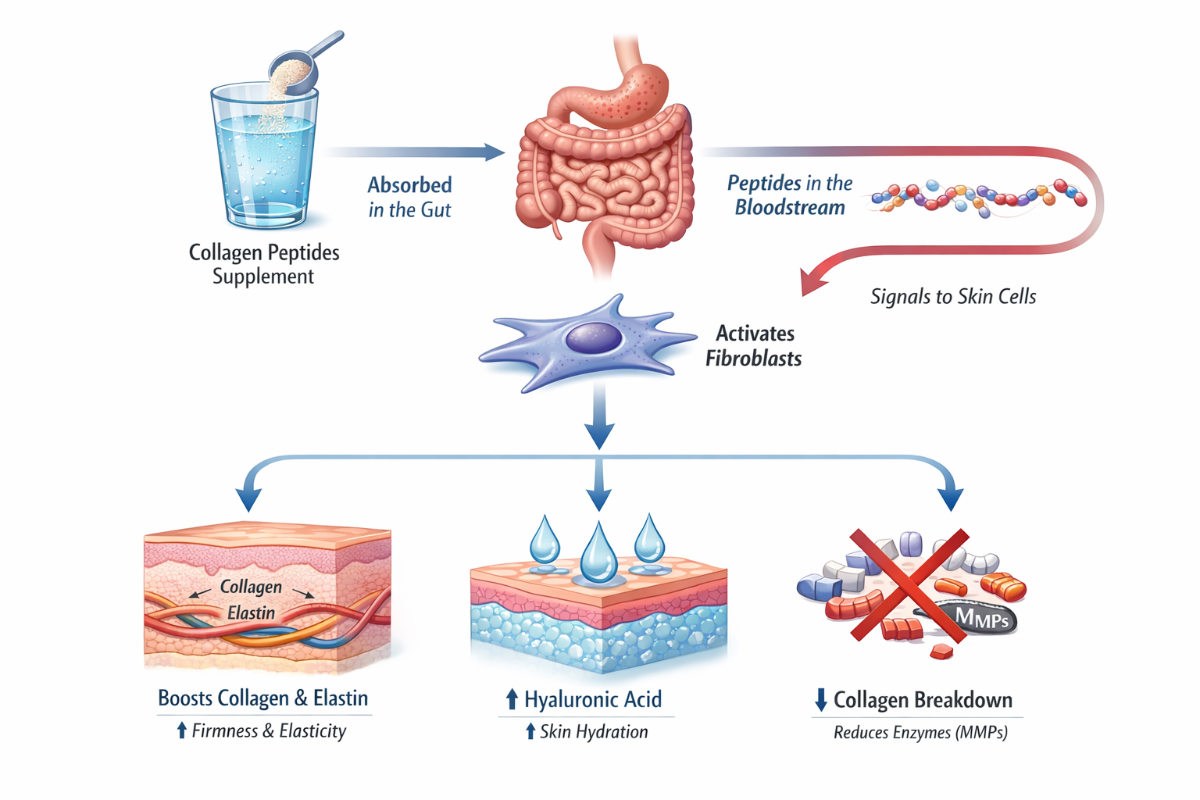
Fibroblasts are particularly sensitive to these peptides because their presence normally indicates that collagen has been broken down somewhere in the body. The body interprets this as a signal that repair is needed and responds by increasing fibroblast activity to rebuild connective tissue.
When we take a collagen supplement, we are essentially mimicking this signal, encouraging fibroblasts to increase collagen production. We are not relying on the collagen in the powder to travel directly to your face and support skin regeneration in that specific area.
Hopefully this is all making sense.
What Does the Research Show?
One criticism often made of collagen supplementation research is that trials can be too small or too short. When studies are small, it reduces our ability to draw strong conclusions because there is a greater chance that the results could be due to chance.
These criticisms apply to many areas of medical research, not just collagen supplements. Sometimes, due to cost and other practical challenges, smaller studies are all that are available.
Scientists can address this by pooling data from multiple smaller studies. By combining the results using specialised statistical techniques, researchers can analyse the data as if it came from a much larger trial. These studies are called meta-analyses.
The study I mentioned earlier is one of these meta-analyses. The authors analysed 113 randomised clinical trials involving almost 8,000 participants to evaluate the effects of collagen supplementation across a range of health outcomes.
This represents the most robust evidence we have to date, and the findings were encouraging for both skin health and joint function.
The research showed that collagen supplementation was associated with improved skin quality, specifically:
Improved skin elasticity
Skin elasticity improved significantly across many studies, meaning skin became more resilient and better able to bounce back after stretching.
Improved skin hydration
Participants taking collagen supplements often showed measurable improvements in skin hydration.
What Collagen Supplements Do Not Do
Collagen supplements are sometimes marketed as miracle anti-ageing products, but the reality is more nuanced.
As we saw above, research suggests collagen supplements are helpful for:
✔ improving skin quality
✔ supporting the dermal matrix
✔ improving hydration and elasticity
However, they do not appear to dramatically improve:
✘ wrinkles
✘ skin roughness
✘ pigmentation
✘ sagging
Yes, you read that correctly – collagen supplements do not do much for wrinkles.
This is because wrinkles and skin laxity are influenced by many other factors, including:
- fat pad changes in the face
- ligament laxity
- bone resorption
- muscle activity
Collagen supplements work primarily at the dermal level, supporting the skin itself rather than lifting or reshaping deeper facial structures. To address those changes we need other treatment approaches such as fillers and Botox injections.
Why Supplementation Should Be Consistent and Long-Term
Skin remodelling is a slow biological process.
The dermis typically takes three to six months to remodel, so improvements from collagen supplementation tend to develop gradually rather than immediately. This is also why results from collagen-stimulating treatments such as radiofrequency microneedling take time to appear.
Unfortunately, if you stop taking collagen supplements, the benefits will gradually fade.
Consistency is therefore key.
Collagen Supplements and Aesthetic Treatments
An interesting area of emerging research is how collagen supplements may support professional skin treatments.
Many of the treatments we perform work by activating fibroblasts and stimulating collagen production. These include:
- fractional lasers (e.g. CO₂ and LaseMD Ultra)
- RF microneedling
- skin boosters (e.g. Profhilo and polynucleotides)
- collagen-stimulating injectables (e.g. Sculptra, Juvelook and Radiesse)
Because collagen peptides also stimulate fibroblasts, they may theoretically support this process by:
- providing building blocks for collagen synthesis
- enhancing the skin’s regenerative response
- supporting healing after treatments
While research is still evolving, collagen supplementation may act as a supportive strategy alongside in-clinic treatments, helping to optimise healing and maximise results.
How to Choose a Collagen Supplement
This area can feel like a bit of a minefield, and much of the information available online is confusing or difficult to interpret. Put simply, not all collagen supplements are the same.
As discussed earlier, research studies typically use hydrolysed collagen peptides, which are small protein fragments that are easier for the body to absorb.
Generally speaking, effective collagen supplements contain:
- hydrolysed collagen peptides small enough to be absorbed (around 2,000–3,500 Da)
- a daily dose of around 2.5–10 g (3–5 g is considered optimal for skin; around 10 g for joint support)
- sometimes additional nutrients such as vitamin C, which supports collagen production
Other factors to consider include the source of collagen (bovine, porcine or marine), the sustainability of that source, and cost.
Current research suggests the collagen source is less important than factors such as peptide quality and dose, and that many additional ingredients included in some products have limited evidence to support their inclusion.
Who Might Benefit Most?
Collagen supplementation may be particularly helpful for:
- people noticing early skin thinning
- individuals with sun-damaged skin
- peri- and post-menopausal skin
- those undergoing collagen-stimulating treatments
Younger individuals with naturally high collagen levels are less likely to notice significant changes. If you are in your 20s save your money and spend it on SPF instead – it is the single best product you can use to future-proof your skin.
Our Approach
At Fitzrovia Clinic, we take a holistic approach to skin health and offer patients a range of evidence-based treatment options.
Collagen supplements may play a supportive role in improving skin quality, but they work best as part of a broader strategy focused on long-term skin health and regeneration.
They are not a replacement for professional treatments or medical-grade skincare. Instead, it is helpful to think of them as supporting the skin from within, rather than delivering dramatic anti-ageing results on their own.
What Collagen Supplements Do We Use?
As many of you know, I am a fan of collagen supplementation. I have genetically thin skin and am conscious of maintaining collagen levels now that I’m in my 40s. I’ve also had three knee surgeries and have a family history of osteoarthritis, so the joint benefits are also important to me.
We have stocked Vida Glow for almost as long as the clinic has been open, and I still rate the brand highly. Their marine collagen is sustainably sourced from fish skin left over from food production.
The individual sachets are convenient, although if you are waste-conscious (like me), you can opt for the glass jar instead. It is fully recyclable and contains three months’ supply for the price of two.
All of their formulations are heat-stable, so the powder can be added to both hot and cold drinks — and I promise there is no fishy smell or taste.
We have a range of options and cost-saving bundle offers available in clinic, so if you are interested, please ask and we can help recommend the right one for you.